- Absence of Government policy and an under-resourced mineral planning system is deterring investment
- Domestic crushed rock reserves are being consumed three times as fast as they are being replaced and sand & gravel twice as fast over the last decade
- Andy Burnham’s agenda needs a secure supply of domestic minerals
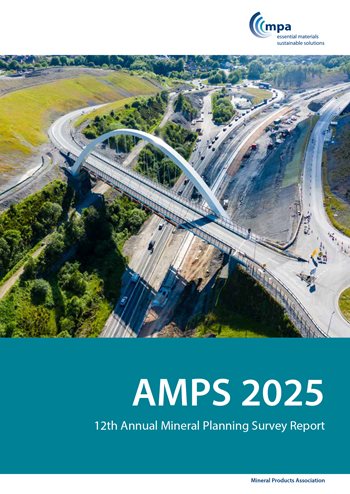 Britain is failing to plan for the future minerals that underpin new homes, infrastructure, manufacturing, energy security and climate adaptation.
That’s according to new evidence published today by the Mineral Products Association (MPA) which is urging the Government to put essential minerals – the largest material flow in the economy - at the heart of its growth agenda by resetting the minerals planning system.
A worsening decline in the long-term replenishment of domestic mineral reserves across Great Britain is revealed in the MPA’s new Annual Mineral Planning Survey (AMPS), based on 2025 figures. This comes a week after the publication of the updated National Planning Policy Framework in England confirmed that a sufficient supply of minerals is essential to provide the infrastructure, buildings green energy and goods the country needs. MPA made a strong case for retaining “essential” in the guidance after the initial draft removed it.
The report warns that Government policy, exacerbated by an under-resourced mineral planning system, is frustrating the industry’s ability to sustain future supply of sand, gravel and crushed rock. The MPA highlights that this will also impact future capacity to produce downstream products like concrete and asphalt, materials essential for homes and infrastructure.
Great Britain has a diverse geology that can provide an abundance of different minerals used in construction and manufacturing, but these resources need investment and permission to be extracted. The only way materials become available is through the under-resourced and unpredictable mineral planning system, which is holding back much-needed investment.
The report examines the long-term replenishment rate of essential minerals, which compares sales volumes from existing permitted reserves and new planning permissions that replenish them. This rate is a key indicator of the resilience of domestic mineral reserves and the country’s ability to meet future needs.
At 122 million tonnes, annual sales of primary aggregates in 2025 fell to their lowest level since 2013 – even below Covid-impacted 2020 levels – yet new permissions for extraction continue to fall further behind the rate of consumption.
Over the past decade, only 49 tonnes of new sand and gravel reserves have been permitted for every 100 tonnes extracted. The position for crushed rock is even more alarming, with just 32 tonnes replaced for every 100 tonnes sold, following 13 consecutive years in which sales have exceeded new permissions. In the East Midlands, Britain's largest crushed rock producing region, sales in the last decade were almost 24 times higher than newly permitted reserves.
The average period from submission to determination for mineral planning applications remains more than two years, with Reviews of Old Mineral Permissions (ROMPs) taking more than three years on average. The report stresses that planning determination is only one stage of a process that can easily take 10 to 15 years before a new quarry is operational.
The AMPS report comes at a crucial moment, with Andy Burnham, the new UK Prime Minister, focusing on reindustrialisation, regional renewal, building at scale and accelerating infrastructure delivery. The MPA is calling on the new administration to recognise that none of these aspirations can be achieved without a sufficient and timely supply of domestic minerals.
According to the MPA, the Government has an opportunity to reset Britain's approach to mineral planning through three specific actions. Mineral planning is devolved, so these apply principally to England, where 75% of production occurs.
- Use the new National Planning Policy Framework to put in place steps that facilitate rather than frustrate the extraction of minerals;
- Update the long-overdue National and Sub-national Guidelines for aggregates provision to provide a robust assessment of future demand;
- Establish specialist regional or sub-regional mineral planning ‘hubs’ to retain expertise and strengthen long-term planning capacity – particularly in light of the changes anticipated under local government reorganisation.
Strategic planning for minerals is vital to ensure Britain maintains a sufficient and timely supply of the essential minerals needed to support economic growth.
Mark Russell, MPA Executive Director for Planning and Mineral Resources said: “The evidence is clear. Britain's mineral reserves are steadily being run down because a lack of investment in the planning system is failing to encourage new permissions from keeping pace with extraction. Even during a period of weaker demand from the construction industry, replenishment rates continue to deteriorate.
“We support Andy Burnham’s aspiration for reindustrialisation - to ‘build more’ and ‘make more’ - but we can’t do that without raw materials. Britain continues to neglect mineral planning, even though this is the only route by which essential raw materials are made available to enable construction and manufacturing. If Government is serious about growth, it must be equally serious about planning for the domestic minerals that make growth possible. The wider planning reform agenda, the revision of the NPPF and local government reorganisation should all provide opportunities to support growth, but the needs of the domestic minerals sector remain a blind spot.”
Every year MPA members supply almost 400 million tonnes of essential raw materials that are the lifeblood of construction and manufacturing. Operating from more than 2,200 sites across every region, the mineral products sector directly employs 89,000 people in a wide variety of skilled roles – that’s more than twice the workforce of Britain’s steel industry and four times the ‘critical minerals’ industry.
ENDS
About the Mineral Products Association:
The Mineral Products Association (MPA) is the trade association for the aggregates, asphalt, cement, concrete, dimension stone, lime, mortar and industrial sand industries. MPA is the sectoral voice for mineral products, covering 100% of UK cement and lime production, 90% of GB aggregates production, 95% of asphalt and over 60% of ready-mixed concrete and precast concrete production. In 2023, the industry supplied £18.4 billion worth of materials and services to the Economy, directly generating £6.7 billion in Gross Value Added (GVA). It is the largest supplier to the construction industry, which generated £141.5 billion in GVA in 2023.
For media enquiries, contact Robert McIlveen at: Robert.McIlveen@mineralproducts.org.