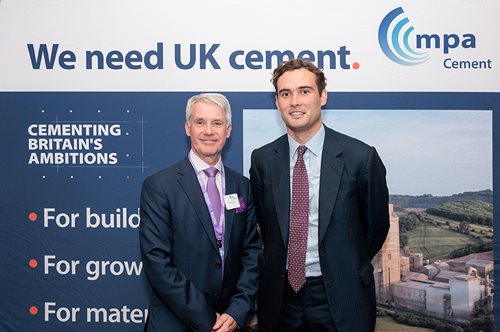
 The Mineral Products Association (MPA) has called on government to favour British-made materials on major public construction projects at a parliamentary reception on 30 June.
The event brought together leading cement producers, MPs, members of the Lords, ministers and government officials to discuss the importance of a secure, reliable cement supply for the country’s building ambitions.
As a main ingredient in concrete, the world’s most used construction material, cement is essential to achieving the government’s housing and infrastructure targets. Speaking at the reception, Henry Tufnell MP noted that cement is fundamental to delivering the homes, clean energy projects and transport networks the UK needs to underpin economic growth. He added that domestic materials production is increasingly a matter of national security and resilience.
Martin Casey, senior director for cement and lime at the Mineral Products Association, said: “We can’t build without cement and based on the government’s ambitious housebuilding and infrastructure goals we’re going to need a lot more of it. It makes sense to channel public investment towards British industry, turbocharging innovation, putting money back into the economy and securing jobs across the UK. Using domestically made materials doesn’t just power growth, it supports resilience and security of supply. Portland cement was invented in Britain over 200 years ago - we have the raw materials and sovereign manufacturing capability to meet demand in this country. Let’s use it.”
Despite its national significance, the cement industry faces serious competitiveness challenges, including sky-high energy costs and uneven carbon taxation. Cement is excluded from the Energy Intensive Industries (EII) Compensation Scheme, leaving domestic producers to battle energy prices much higher than those faced by overseas competitors.
New MPA data shows that climate and energy policies now cost the British cement sector a combined £82 million, almost double that of 2015 (£45 million). This is despite the sector decarbonising faster than the UK economy as a whole – along with the concrete industry, it has cut emissions by 63 per cent since 1990. The £82 million includes network charges and direct and indirect costs from policies such as the Emissions Trading Scheme and Carbon Price Support, which is not expected to be removed until 2028.(1)
The MPA has called for continued backing for carbon capture and storage in cement, which could reduce the sector’s emissions by 75 per cent by 2035, and cut construction emissions by up to 3.8 million tonnes of CO₂ a year.(2)
Concerns also remain around gaps in the government’s incoming Carbon Border Adjustment Mechanism and its ability to genuinely level the playing field between emissions charges for British producers and imports. The MPA has warned that if legislation isn’t robust, it could encourage carbon leakage, offshoring emissions rather than reducing them. Since the EU CBAM was introduced at the start of this year, official figures show that non-EU imports of cement to the UK hit a 10 year high in March 2026(3), as product was diverted to avoid paying additional European charges.
Martin Casey said: “Cement is a productive, growth generating industry. We need to back this kind of sector and create the conditions for it to thrive, not push it to the brink. We can have a successful, decarbonised British cement industry that underpins construction targets, but we have to act now – creating the fair, stable conditions needed for long term investment.”
ENDS
Image: Martin Casey and Henry Tufnell MP
Notes for editors:
For more information about the UK concrete and cement sector, please visit: https://mpa-cement.uk/ and https://thisisukconcrete.co.uk/
- Cumulative energy and climate burden costs have been calculated using data from publicly available records, including the Office for National Statistics (ONS), Ofgem, the Department for Energy Security and Net Zero (DESNZ) and the Department for Business, Energy and Industrial Strategy (BEIS) alongside MPA member supplied data on figures including TNUoS and DUoS network charges. The figures take into account direct policy costs, indirect policy costs, network and other costs, as well as any relief provided to the sector. The data includes costs from the Emissions Trading Scheme (ETS), red diesel, CPS and CfD, FiT, capacity market charges and others. The full list is available on request. This data assumes that Padeswood CCS will become operational in 2029. The MNZ | Peak Cluster project is not modelled into the data as there is no confirmed date for completion.
- The 2035 estimates for CO2 per tonne of cement are calculated using the 2024 figures as a base, assuming that the Padeswood and Peak Cluster projects capture 3.8 million tonnes of CO2 per year by 2035, and that the only reduction in emissions between now and 2035 is due to CCUS implementation.
- Non-EU imports were at their highest monthly figure of the last 10 years at 96,000 tonnes in March 2026, compared to 37,000 tonnes in March 2025. Non-EU imports have made up 27 per cent of imports in Jan-Mar 2026, compared to 14.5 per cent in 2025 and generally less than 10 per cent since 2016. This data is downloaded from HMRC’s Trade Information website. It uses HS codes, for cement: 252329 “Portland cement (excl. white, whether or not artificially coloured)”. The data is on a like for like basis, i.e. comparing January to March 2026 with January to March 2025.
About the Mineral Products Association:
The Mineral Products Association (MPA) is the trade association for the aggregates, asphalt, cement, concrete, dimension stone, lime, mortar and industrial sand industries. MPA is the sectoral voice for mineral products, covering 100% of GB cement production, 90% of GB aggregates production, 95% of asphalt and over 60% of ready-mixed concrete and precast concrete production. In 2023, the industry supplied £18.4 billion worth of materials and services to the Economy, directly generating £6.7 billion in Gross Value Added (GVA). It is the largest supplier to the construction industry, which generated £141.5 billion in GVA in 2023.
For media enquiries, contact Camargue: cement@camargue.uk / 0207 636 7366