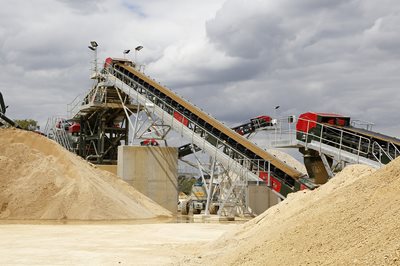
 The strategic importance of aggregates to global economic development and nature recovery has been highlighted in a new UN study launched in Geneva, Switzerland on 13th May 2026.
The MPA, which represents the vast majority of UK aggregate producers, has endorsed the new UN Environment Programme (UNEP) report Sand and Sustainability: An Essential Resource for Nature and Development. As the world’s most extracted solid material, sand remains a critical yet undervalued resource according to UNEP.
In the report, UNEP acknowledges that sand resources – encompassing all primary aggregates including sand, gravel and crushed rock – are essential for built development and infrastructure and that their supply cannot be assumed. Equally, the report contends that sand is a key part of many active ecosystems, contributing to natural habitats, food and water security, climate resilience, flood risk reduction and tourism.
The UK is cited by UNEP as demonstrating examples of good practice, highlighting its structured regulatory and licensing approach for marine extraction, its science-led monitoring system and a responsible approach to land-based extraction and restoration. That’s in stark contrast to many developing countries where extraction activities can be poorly controlled and regulated, allowing sand to be removed from active geological systems like rivers and beaches, with little consideration of the impacts on local communities or natural ecosystems.
The report also calls for greater use of sustainable alternatives such as secondary aggregates (by-products other industrial processes) and recycled aggregates (made from construction, demolition and excavation waste). That’s another area in which the UK is a global leader with almost 30% of aggregate demand already being met from secondary or recycled sources.
Other areas addressed in the report include the importance of responsible sourcing in the supply chain. Here, UNEP recommends embedding responsible sourcing standards into public tenders, requiring transparency, environmental safeguards, long-term material planning, and international standards, while moving beyond lowest-cost procurement to include environmental and social impacts in decision-making. In the UK, 96% of domestic concrete production is certified to BES 6001, the standard for responsibly sourced construction materials.
Mark Russell, MPA Executive Director for Planning & Mineral Resources said: “In this report UNEP recognises sand resources – including sand, gravel and crushed rock – as a strategic mineral that’s absolutely essential for economic development. This represents a truly global issue as even in developed economies like the UK, the need for - and supply of - essential minerals that underpin our built environment and wider economic activity can be taken for granted. UNEP has once again highlighted that, for all the attention on critical minerals, there needs to be equal recognition of the role and importance of sand.
“The report also stresses the role of sand in nature, especially in sensitive ecosystems, and the importance of strong governance and responsible extraction to ensure supplies can be met sustainably. MPA appreciated the opportunity to contribute to this UNEP study, sharing the experiences of the UK’s strong track record in operating to the highest standards and delivering outstanding quarry restoration schemes that can significantly increase biodiversity. We hope our approach can help inform and inspire practices elsewhere in the world as a result of the report.
The report calls for stronger governance, better integration of environmental considerations, and sustainable sand management to balance development needs with long-term ecological and societal resilience.
“The UNEP report identifies 24 recommendations which provide practical solutions to support the sustainable supply of this strategic resource. Taken collectively, the measures identified can help to ensure the essential sand, gravel and crushed rock that every society around the world requires can be planned, managed and extracted responsibly with a net benefit to the natural environment as well as the built environment,” Russell concluded.
ENDS
About the Mineral Products Association:
The Mineral Products Association (MPA) is the trade association for the aggregates, asphalt, cement, concrete, dimension stone, lime, mortar and industrial sand industries. MPA is the sectoral voice for mineral products, covering 100% of GB cement and lime production, 90% of GB aggregates production, 95% of asphalt and over 60% of ready-mixed concrete and precast concrete production. In 2023, the industry supplied £18.4 billion worth of materials and services to the Economy, directly generating £6.7 billion in Gross Value Added (GVA). It is the largest supplier to the construction industry, which generated £141.5 billion in GVA in 2023.
For media enquiries, contact Robert McIlveen at: Robert.McIlveen@mineralproducts.org